Meet Scout, our mascot. (She prefers Talent Cartographer-in-Residence.)
In recruiting, the purple squirrel is the perfect candidate nobody ever actually finds. Then one walked into our office and started asking questions.
She just appeared one Monday
Nobody at Recruise can tell you exactly when Scout arrived.
Or how a purple squirrel got past building security. Or why, of all the offices in all the business parks in Bangalore, she picked ours.
She was just there one Monday, sitting on the edge of a hot desk, reviewing someone’s shortlist with visible disappointment.

Then came the questions
Here’s the thing you have to understand. In our industry, the “purple squirrel” is a legend — recruiter slang for the perfect candidate. The one who ticks every box on an impossible brief. The exact skills, the exact sector, the exact stage, all in one person. Hiring managers describe them. Recruiters chase them. Almost nobody actually sees one.
We had one eating cashews out of the good snack drawer.
Naturally, we had questions. She had more.
How deep does your market mapping actually go? Do you challenge a brief when it’s over-engineered, or do you just nod? What happens to a candidate you don’t place — do they hear back? How many of your searches close on the first shortlist? And who signed off on this job description, because seventeen requirements is not a role, it’s a wish list.
She grilled everyone. Researchers. Partners. We’re fairly sure she cornered our founder by the coffee machine, though he maintains it was “a normal conversation” and refuses to elaborate.

Every recruiter claims a sighting
How does a squirrel know this much about executive search? We asked. She looked at us the way you’d look at someone who asked why water is wet. Our working theory: when you’ve spent your whole existence being the most hunted creature in recruiting — the candidate every firm claims they can find — you develop opinions about who’s actually any good at the finding.
Because that’s the part we eventually pieced together, from overheard fragments and one cryptic sticky note. Scout had been auditioning recruiters. For years. Firm after firm, market after market, watching how they searched, who they called, whether they told clients the truth when the perfect candidate didn’t exist. Most firms, she implied, talk about purple squirrels the way people talk about yetis — enthusiastically, and with no credible sightings.

The nod, and the vanishing act
She was looking for someone who could genuinely find her kind. Rare people, in small pools, for briefs where the qualified population worldwide fits in a single conference room.
Then one afternoon the questions stopped. She sat very still for a moment, tail curled into something suspiciously like a checkmark, and gave a small, satisfied nod.
Some people say she vanished up the air-conditioning duct in a flash of purple. Others say she took the lift like everyone else, because she’s rare, not dramatic. The stories vary.
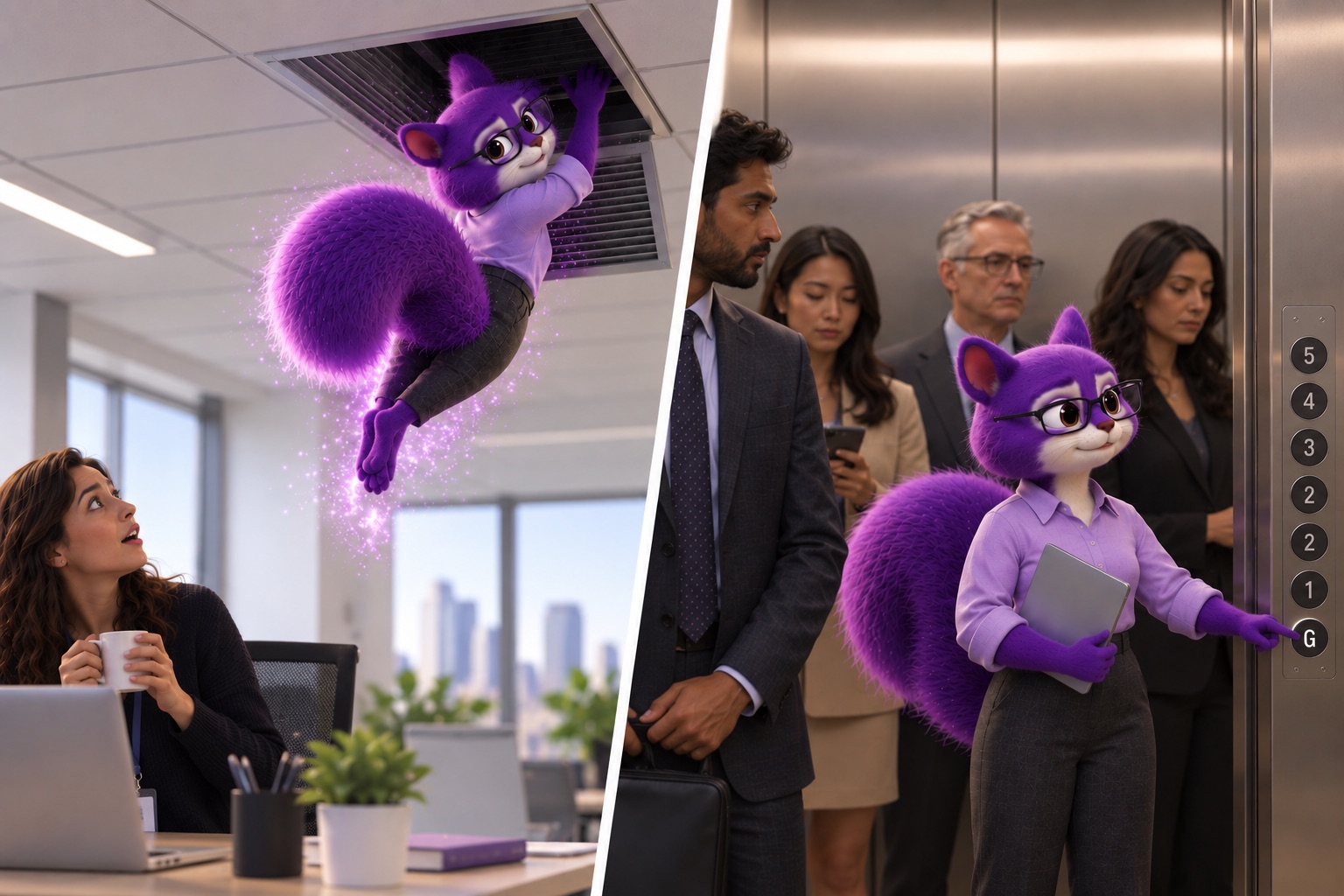
The fan we didn’t plan for
What we know for certain is that she never really left. She’s on our site now, in our decks, perched in the corner of our reports — publicly, conspicuously vouching for us. The rarest candidate in recruiting, endorsing the people who hunt for the rarest candidates. She seems to find this funny.
For the record: we call her our mascot, but she’s rejected every attempt to formalise the arrangement. We offered her a title. (“I don’t do titles. Titles are how briefs get over-engineered.”) We offered her a retainer. She asked if we’d read anything she’d taught us at all.
Having a purple squirrel for a fan wasn’t exactly on our company roadmap. But maybe, in the end, she’s exactly the fan we needed. We won the trust of an impossible-to-please, mysterious purple squirrel — and we don’t plan to give her a reason to change her mind.

One hiring pattern worth knowing, every ten days.
The Mandate Desk is our read on the senior GCC talent market — one signal that moved, the read behind it, and one thing worth doing. Written from live placement data.
More from Recruise Insights.
 AI in the Workplace
 Which AI economy is your GCC's leadership hiring built for?
Anthropic modelled three AI economies to 2030. In the middle one AI can do half of all knowledge work, and GCC leadership hiring should plan for it.
 Talent & Recruitment
 How the choice gets framed decides who gets hired
Same candidates, same brief, a different set of words, a different hire. Four decades of framing research, applied to shortlists, briefs and offers.
 GCC Leadership
 Three team models to retire, and the one AI makes worse
Tuckman, Belbin and Hawthorne rest on thin or misread evidence, and an agreeable AI makes the Abilene paradox worse. What GCC heads can do instead.
Have a senior seat to fill?
Tell us the mandate — the role, the level, the market. We’ll come back with what the market is really doing on it, and how we’d run the search.